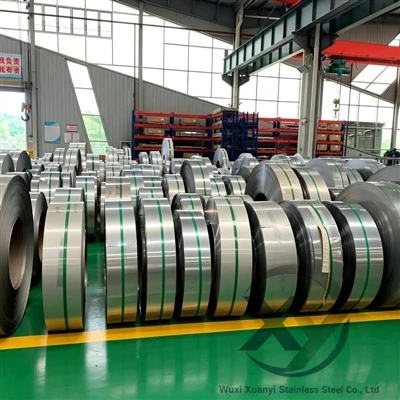


If you've ever stood in front of a warehouse shelf stacked with cold rolled stainless steel coil, you might have thought they all look the same-sleek, silver, ready to be cut or formed for everything from kitchen sinks to industrial machinery. As someone who's spent the last decade supplying and working with these coils, I can tell you that's far from the truth. The differences between coils from different manufacturers run deeper than just a surface-level look, and understanding those gaps can mean the difference between a project that runs smoothly and one that hits costly snags. Let's break down what sets these coils apart, why it matters, and how to avoid the pitfalls that come with picking the wrong supplier.
First, let's start with the basics: cold rolling isn't just a single process. It's a method of shaping stainless steel at room temperature, which gives it a tighter surface finish, better dimensional accuracy, and higher strength than hot rolled steel. But how a manufacturer executes that process changes everything. Take material chemistry, for example. Most stainless steel coils (like the common 304 or 316 grades) rely on a mix of iron, chromium, nickel, and sometimes molybdenum for corrosion resistance and strength. But some manufacturers cut corners here. I've seen coils labeled as 304 that had 2-3% less nickel than the industry standard-enough to save a few dollars per ton, but not enough to hold up in outdoor applications or acidic environments like food processing plants. This isn't a small issue; a 304 coil short on nickel will rust in 1-2 years instead of the 10-15 years you'd expect.
Then there's surface quality. Cold rolled coils are supposed to have a smooth, blemish-free finish for most applications, right? Not always. Some manufacturers use older rolling mills that leave tiny scratches, pits, or uneven patches on the steel surface. These defects might not show up when the coil is rolled flat, but when you form it into a curved shape-like a pipe or a decorative trim-those small flaws become visible. I once had a customer come to me with a batch of coil from another supplier that had so many surface inconsistencies, they had to reject 40% of it before it even reached their stamping line. That kind of waste isn't just a hassle; it's a hit to a project's timeline and budget. If you're looking for consistent surface quality, checking for a manufacturer's control over rolling mill maintenance is key. Look for specs that mention annual mill calibration and in-process surface inspection-these steps add a bit to the cost, but they save you from rework.
Dimensional accuracy is another big differentiator. Cold rolled stainless steel coil needs to be precise: if the thickness varies by even 0.02 mm, it can throw off everything from welding to coating lines. Some manufacturers use lower quality raw material for their starting slabs, which means their rolling mills have to work harder to get to the final gauge. That work can cause the edges to warp or the center to be slightly thicker than the edges. This "gauge inconsistency" is a silent problem until it's too late. I remember a job where a customer used a coil from a supplier that had a 0.05 mm thickness variation across its 1.5-meter width. When they ran it through their laser cutter, the machine had to adjust the pressure mid-cut, leading to uneven edges and 25% of the cuts being scrap. For high-precision applications-like automotive parts or medical devices-dimensional tolerance isn't a minor detail; it's a non-negotiable requirement.
Heat treatment and processing after rolling also make a huge difference. After cold rolling, stainless steel is often annealed (heat-treated) to restore its ductility and remove internal stress. If a manufacturer skips or rushes this step, the coil will be too brittle to form without cracking. I've had to help customers rework parts made from these brittle coils because they split during bending, costing them thousands in material and labor. On the flip side, some manufacturers over-anneal, softening the steel so much that it loses some of its strength. This isn't a problem for decorative uses, but it's a critical flaw for structural parts that need to hold weight or pressure. Asking a supplier about their annealing process-like the temperature they use, the hold time, and the cooling method-will tell you a lot about how much they care about their product's performance.
Packaging and handling might seem like a small detail, but it's a common source of variation between manufacturers. Some suppliers use heavy, wooden crates with moisture barriers and edge protectors, so when the coil arrives at your facility, it's free of rust, scratches, and dents. Others just wrap the coil in a thin plastic sheet and stack it on a pallet. I once saw a batch of coils from a foreign supplier that arrived with rust spots all over because the plastic tore during shipping and the coil sat in rain for two weeks. Even if the material was chemically correct, that rust made it unusable for food-grade applications. For projects that require clean, untouched material, packaging is part of the product quality-don't overlook it when comparing suppliers.
Now, you might be wondering how to tell all this apart before you place an order. Let's talk about how to vet a supplier beyond just price. First, ask for third-party test reports. Reputable manufacturers will give you mill test certificates (MTCs) that list the material chemistry, gauge accuracy, surface quality, and tensile strength of each batch. If a supplier hesitates to share these, that's a red flag. Second, ask for a sample. A 1-meter cut of coil costs almost nothing, and it lets you run your own tests-like checking the thickness with a micrometer, doing a surface inspection, or even bending a small piece to see how it holds up. Third, look at their track record. How long have they been making cold rolled stainless steel coil? Do they work with clients in your industry? For example, if you need food-grade material, a supplier that only makes coils for construction might not have the strict quality controls you need.
At the end of the day, the right cold rolled stainless steel coil depends on your project's specific needs. If you're making a decorative sign, a slightly lower grade with a smooth surface from a reputable supplier might be perfect. If you're building a heat exchanger that will handle high temperatures and corrosive fluids, you need a 316 grade with exact molybdenum content from a manufacturer that controls every step of the process.
If you're ready to source cold rolled stainless steel coil that's consistent, reliable, and tailored to your project's needs, we're here to help. We partner with mills that adhere to strict quality standards, so every batch we send comes with full test reports, precise dimensional tolerances, and careful packaging to ensure it arrives in perfect condition. Whether you need a small quantity for a prototype or a large volume for a mass production run, we can work with you to find the right coil at a fair price. To discuss your requirements and get a custom quote, feel free to reach out to our team-we're happy to answer any questions you have about material specs, processes, or delivery timelines.
References
- Stainless Steel Manufacturers Association. (2022). "Cold Rolled Stainless Steel: Processing, Properties, and Applications." Industry Technical Report.
- American Society for Metals. (2021). "Metallurgical Considerations in Cold Rolling of Stainless Steel." Metals Handbook, 10th Edition.
- International Organization for Standardization. (2020). "ISO 9445: Continuous Cold Rolling of Stainless Steel – Technical Delivery Conditions." ISO Standards.
- Nickel Institute. (2023). "The Role of Nickel in Stainless Steel Corrosion Resistance." Technical Brief.
- Manufacturing Extension Partnership. (2022). "Quality Control Best Practices for Metal Coil Processing." U.S. Department of Commerce Report.